
10.1 Confirmation Bias: Difference between revisions
More actions
Winstonyin (talk | contribs) |
Winstonyin (talk | contribs) |
||
| Line 33: | Line 33: | ||
* Modern social media offer a perfect environment for selective exposure, where one only chooses to view content created by those that already confirm their preexisting worldview or beliefs. Content moderation algorithms of major websites exacerbate the problem by reinforcing one's choice in the type of "desirable" content, leading to the "filter bubble". | * Modern social media offer a perfect environment for selective exposure, where one only chooses to view content created by those that already confirm their preexisting worldview or beliefs. Content moderation algorithms of major websites exacerbate the problem by reinforcing one's choice in the type of "desirable" content, leading to the "filter bubble". | ||
* As a counterexample, when testing whether a web form taking an email address has been coded correctly, a programmer not only tries "sensesensibilityscience@berkeley.edu" to see if it works, but also non-email address strings like "https://berkeley.edu", "laf1209#$%^&", "Robert; DROP TABLE Students" to see if it breaks. The programmer actively seeks to disconfirm their hypothesis that "the web form is coded correctly". | * As a counterexample, when testing whether a web form taking an email address has been coded correctly, a programmer not only tries "sensesensibilityscience@berkeley.edu" to see if it works, but also non-email address strings like "https://berkeley.edu", "laf1209#$%^&", "Robert; DROP TABLE Students" to see if it breaks. The programmer actively seeks to disconfirm their hypothesis that "the web form is coded correctly". | ||
* The measured value of the Hubble parameter (which describes the speed of the expansion of the Universe) published over time. The few early measurements are clearly too far away from the currently accepted value and overconfident, but they confirmed the accepted value at that time. As soon as one deviating value was published, a slew of publications finally came to support this new value. [[File:H0 over Time.jpeg|center|400px]] | |||
=== Common Misconceptions === | === Common Misconceptions === | ||
Revision as of 09:28, 28 November 2021
| Fill out the learning goals and definitions. |
| Add links in learning goals. |
| Write the "context" for how this lesson connects with others. |
| Edit previous lesson to see if there's any setup for this lesson that needs to be in the "During Class" or "After Class" section of the last. |
| Fill out the lesson content. |
| Fill out or delete anything with "[...]" remaining. |
Learning Goals
[Link to PlayPosit]
[Link to instructional video]
After this lesson, students should
- Be wary of one’s own tendency towards motivated reasoning and confirmation bias.
- Be able to explain how different forms of confirmation bias (i.e., selective exposure, biased assimilation) can lead to errors.
Definitions
- Confirmation bias
- Seeking or otherwise favoring evidence consistent with what is already believed or what is being tested.
- Selective exposure
- Selectively seeking or exposing oneself to evidence that is likely to conform to prior beliefs or working hypotheses.
- Biased assimilation
- Systematically favoring or discounting evidence to render that evidence more compatible with pre-existing beliefs or working hypotheses.
Examples
- Modern social media offer a perfect environment for selective exposure, where one only chooses to view content created by those that already confirm their preexisting worldview or beliefs. Content moderation algorithms of major websites exacerbate the problem by reinforcing one's choice in the type of "desirable" content, leading to the "filter bubble".
- As a counterexample, when testing whether a web form taking an email address has been coded correctly, a programmer not only tries "sensesensibilityscience@berkeley.edu" to see if it works, but also non-email address strings like "https://berkeley.edu", "laf1209#$%^&", "Robert; DROP TABLE Students" to see if it breaks. The programmer actively seeks to disconfirm their hypothesis that "the web form is coded correctly".
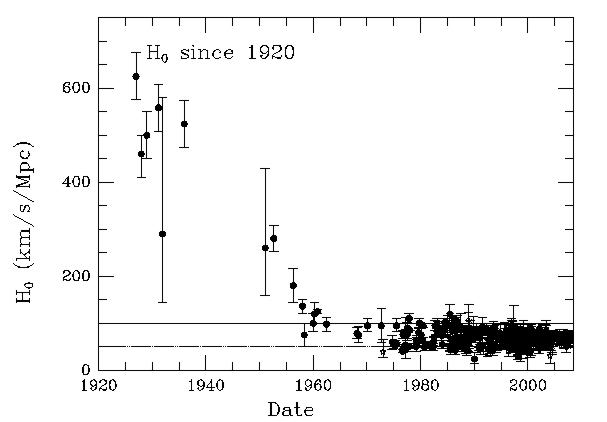
- The measured value of the Hubble parameter (which describes the speed of the expansion of the Universe) published over time. The few early measurements are clearly too far away from the currently accepted value and overconfident, but they confirmed the accepted value at that time. As soon as one deviating value was published, a slew of publications finally came to support this new value.

Common Misconceptions
- Mistaken quote
- Explanation.
Context
[Explanation of how the current topic into the larger context of the course by explaining how the previous topic(s) relate to the current topic and leaving cliffhangers for future topics where relevant throughout the lesson]
Before
- X.X Lesson Name
- Explanation.
- Itemized explanation.
After
- X.X Lesson Name
- Explanation.
- Itemized explanation.
Recommended Outline
Before Class
- [Any essential logistical things that need to be done for this class]
- Prepare a seating chart.
- Review PlayPosit and discussion questions and ask faculty, Gabriel, or Emlen any questions you have.
- (Optional) Prepare a presentation.
During Class
- (5 min) Come up with some fun way to assign the roles of spokesperson and notetaker (e.g. earliest birthday in the year, lives furthest from campus). Remind them of the responsibilities of these roles.
- ([#] min) [Description of some module from #Lesson Content]
- (5 min) Collect questions for plenary.
After Class
- [Any essential logistical things that need to be done as followup for this class]
- Collect answers from notetakers for the forum / plenary.
Lesson Content
Clicker Question
- Question
Correct answer. - First option
- Second option
- Third option
- Fourth option
Activity 1: Name
[Brief description of and motivation for the activity]
| Common misconceptions and any useful tricks, tips, guidelines, or other background |
Instructions
Discussion Questions
- Question 1
- Subquestion a
Possible misconception that may need to be corrected and clarified. Intended answer to the above question.
- Subquestion b
- Subquestion a
Collect Questions for Plenary
(5 min) Collect remaining questions from the students for faculty in plenary (can be questions for clarification, extension, discussion, etc.), and add [ here].
What relevance does confirmation bias play in Vice Provost García Bedolla's Fireside Chat?
(Hint. The following passage can help you if you are stuck): "I think, lifting up, what I was just saying about trusting your gut? I think often we, when we are in spaces, it's easy to go along with what's dominant, or it's easy to do what everyone else is doing, or it's easier to be part of the crowd. And I think often we see opportunities or we see things that don't feel quite right and doing something about that or going down that road feels really risky. But what I like to tell my students is any trend, if you can see it it's over. And so in fact, building something new may be very difficult, but that's where the real payoff comes. And to just trust that you, we stand on the shoulders of giants and that you are here representing lots of people like you. And so, if you see something wrong or see a place where change needs to happen or see something that you think is important to either change or do or influence, that you trust yourself, that you're right in that analysis and that you are willing to take the risk."