
11.2 When Is Science Suspect: Difference between revisions
More actions
// Edit via Wikitext Extension for VSCode Tag: Reverted |
// Edit via Wikitext Extension for VSCode Tag: Reverted |
||
| Line 32: | Line 32: | ||
# Recognize that you yourself are always involved in some social dynamic that may be relevant to the assessment of any particular study of human groups. | # Recognize that you yourself are always involved in some social dynamic that may be relevant to the assessment of any particular study of human groups. | ||
{{BoxCaution|While it may be easy to spot cases where science has been used ''intentionally'' to validate preexisting societal power structures, the goal of this lesson is to bring attention to the possibility that one may ''inadvertently'' use science in such a way, through negligence or even with the best intentions, especially when it comes to the study of human groups.}} | {{BoxCaution|While it may be easy to spot cases where science has been used ''intentionally'' to validate preexisting societal power structures, the goal of this lesson is to bring attention to the possibility that one may ''inadvertently'' use science in such a way, through negligence or even with the best intentions, especially when it comes to the study of human groups.}} | ||
<br /> | |||
|-|Definitions= | |-|Definitions= | ||
Revision as of 12:57, 14 August 2023

The capacity for science to be misused to reinforce existing power structures.
The Lesson in Context
After discussing how science may go wrong in its form in 11.1 Pathological Science, we now discuss how science may go wrong in its societal outcome. Through a discussion activity, students will appreciate the difficulty in measuring humans in a way that is absolutely free of confounds that have discriminatory implications, and thus learn the importance of social responsibility as a scientist and including a more representative array of voices in selecting scientific questions and designing measures.
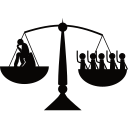
- If science is to be used in societal decision making, scientists must be mindful of its potential to cause harm.
- When studying humans, it is often necessary to define terms operationally, such as "what behaviors constitute altruism." Such operationalizations may be a crude measure of a more realist human trait, if one even exists. Cultural and personal biases may easily cause such definitions to favor the researchers' own group at the expense of others.
- It is tempting, though improper, for scientists to only publish results in a way that confirms the predominant belief. When it comes to human groups, this belief may be a mere stereotype.
Takeaways
After this lesson, students should
- Recognize the potential to abuse science for social and political ends.
- Show heightened caution in situations in which science involves the study of human groups and subsequent validation of societal power structures.
- Recognize that you yourself are always involved in some social dynamic that may be relevant to the assessment of any particular study of human groups.
While it may be easy to spot cases where science has been used intentionally to validate preexisting societal power structures, the goal of this lesson is to bring attention to the possibility that one may inadvertently use science in such a way, through negligence or even with the best intentions, especially when it comes to the study of human groups.
Just World Fallacy
Reliability
We often consider both a metric's reliability and validity together. The latter was introduced in 1.2 Shared Reality and Modeling and 6.1 Correlation and Causation.
[Example Name]
- [Example Description]
[Example Name]
- [Example Description]
[Description of misconception.]
[Description of misconception.]
Useful Resources
[[address] Discussion Slides Template]
[[address] The discussion slides for this lesson.]
[[address] [Title]]
[[address] [Description.]]
[[address] [Title]]
[[address] [Description.]]
[[address] [Title]]
[[address] [Description.]]
[[address] [Title]]
[[address] [Description.]]
Recommended Outline
Before Class
[Any steps that need to be taken before class.]
During Class
| [n] Minutes | [Activity.] |
| [n] Minutes | [Activity.] |
Lesson Content
Activity 1
[Brief description of and motivation for the activity]
[Common misconception or thing to look out for.]
[Thing you really need to look out for!]
[Title]
[Useful tip, guideline, or other background.]
Instructions
| [n] Minutes | [Activity.] |
| [n] Minutes | [Activity.] |
Discussion Questions
[Question 1]
[Possible misconception that may need to be corrected and clarified.]
[Intended answer to the above question.]
[Question 2]
[Possible misconception that may need to be corrected and clarified.]
[Intended answer to the above question.]