
2.1 Senses and Instrumentation: Difference between revisions
More actions
// Edit via Wikitext Extension for VSCode |
|||
| Line 72: | Line 72: | ||
* Hand out worksheets. | * Hand out worksheets. | ||
* The first three activities are fun and can stretch out into extra time. Do save some time to get to the discussion questions at the end. | * The first three activities are fun and can stretch out into extra time. Do save some time to get to the discussion questions at the end. | ||
* (5 min) | * (5 min) Introduce the lesson and go over the plan for the day. If you want, come up with some fun way to assign the roles of spokesperson and notetaker (e.g. earliest birthday in the year, lives furthest from campus). Remind them of the responsibilities of these roles. | ||
* (3 min) Ask the [[#Clicker Question|clicker]] question to loosen the students up and get them ready to be convinced of their capacity to understand reality. | * (3 min) Ask the [[#Clicker Question|clicker]] question to loosen the students up and get them ready to be convinced of their capacity to understand reality. | ||
* (18 min) Do [[#Spectra of Sound|activity 1]] (sound spectra). | * (18 min) Do [[#Spectra of Sound|activity 1]] (sound spectra). | ||
Revision as of 18:58, 27 October 2022
Useful Links
Learning Goals
After this lesson, students should
- Place appropriate trust in instruments where direct observation is not possible (or is less precise/accurate).
- Understand that interaction with reality through instruments can extend the belief of a shared objective reality to objects and phenomena to which our raw senses do not have direct access.
- Understand the challenges of validating an instrument and methods of validation.
Definitions
Challenges in validating the use of an instrument:
- When there is no objective gold standard (e.g. passage of time, what fluid to use in a thermometer)
- When direct observation is messy or impossible (e.g. radio waves, mass of a mountain)
Techniques for validating instruments:
- Interactive exploration
- Testing an instrument by changing the thing it is measuring in ways you know through other means, and seeing if the instrument recognizes the changes appropriately (e.g. does driving increase a car's odometer; see how singing higher and lower notes affects a sound spectrograph; sprayable electrons in Hacking reading).
- Comparison of multiple instruments (e.g. thermometers)
- Comparison to direct observation (e.g. naked sight compared to sight with a magnifying glass)
Common Misconceptions
- Why should we trust our senses at all if they can be fooled by, say, optical illusions or hallucinations? Why should we trust instruments at all if they are imprecise and may have a defect?
- It is important to teach that our senses and instruments don't have to be 100% infallible to be useful in making practical decisions. In fact, all instruments fail beyond a certain range of validity, but we can still use them to learn about the shared reality.
Context
This lesson links the idea that there's a shared reality "out there" and the beginnings of our comprehension about it. It does this by providing the foundation for why we can trust that the instruments we use are in fact measuring something real about reality. The lessons after this are about how we interpret the results of our measurements and start to unpack what they're actually telling us about reality.
Before
- 1.2 Shared Reality and Modeling
- Senses and instruments as means to study the shared reality.
- Ways to help us feel "real" about things we can't directly see.
After
- 2.2 Systematic and Statistical Uncertainty
- Accept that instruments are inaccurate or imprecise.
- Ways to quantify this inaccuracy and imprecision in our measurements.
- 6.1 Correlation and Causation
- The value of interactive exploration can be understood in terms of causation as "correlation under intervention."
Recommended Outline
Before Class
- Prepare a seating chart.
- Have students download a spectrogram app on their phones for Activity 1.
- iOS devices can use this link.
- Android devices can use this link.
To make the Android app display readings in the same way as the iOS one, students may have to push the button that says "1D" at the bottom of the screen. This switches the app to "2D" mode. 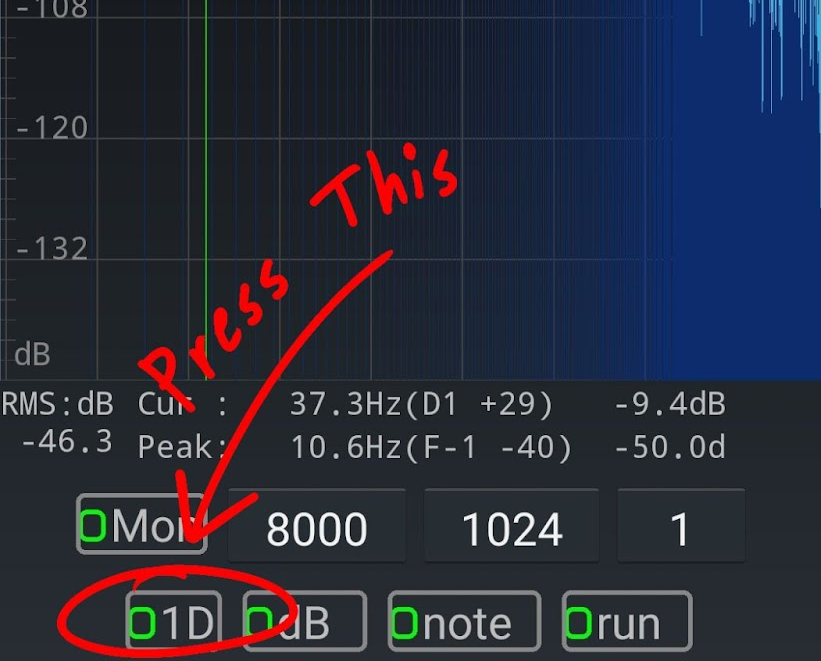
- Review and print worksheets for students.
- Get all materials for activities from the physics demo office in 72 Physics:
- Slinkies (may need a weight with each, one per group)
- Gas lamp (any kind will do, one per class)
- Diffraction grating (one per person)
- Review PlayPosit and discussion questions and ask faculty, Gabriel, or Emlen any questions you have.
- (Optional) Prepare a presentation.

During Class
- Remind students to sit according to the posted seating chart.
- Hand out worksheets.
- The first three activities are fun and can stretch out into extra time. Do save some time to get to the discussion questions at the end.
- (5 min) Introduce the lesson and go over the plan for the day. If you want, come up with some fun way to assign the roles of spokesperson and notetaker (e.g. earliest birthday in the year, lives furthest from campus). Remind them of the responsibilities of these roles.
- (3 min) Ask the clicker question to loosen the students up and get them ready to be convinced of their capacity to understand reality.
- (18 min) Do activity 1 (sound spectra).
- (18 min) Do activity 2 (light spectra).
- (18 min) Do activity 3 (slow motion camera).
- (7 min) Ask the post-activity discussion questions.
- (7 min) Answer student questions and review definitions.
After Class
Collect answers from note takers for the forum and plenary.
Lesson Content
| This is a logistically heavy lesson. Please consult an experienced team member far in advance to plan and prepare the necessary materials. The physics demo office may need to be contacted. |
Clicker Question
- Which statement best captures your stance?
- I strongly feel the pull of the arguments about limits of our understanding of reality.
- I strongly feel their pull, but I think there is a little room for our understanding of reality to be essentially correct some of the time.
- I strongly feel their pull, but I am still somehow pretty sure our basic sense of reality is generally right in many of the most important ways.
- I strongly feel their pull, but I am still somehow pretty sure our basic sense of reality is generally right in many of the most important ways.
Spectra of Sound
In this activity, students use a spectrogram app on their phones to interactively explore the frequency composition of different sounds and voices. Seeing the spectrogram immediately respond to different sounds should give the students a sense that it's measuring something real. This can be concluded because the spectrum showed in the app clearly and consistently respond to the sounds the students expose it to.
Instructions
- Prior to class, make sure the students download a spectrogram app on their phones.
- (2 min) Introduce the activity by opening the app on your phone and singing or whistling out loud into it. But, don't show them the results of your measurement.
Students might not feel comfortable singing out loud around a bunch of strangers. Having the instructor making a fool of themself encourages the students to do the same. - (8 min) Have the students explore different sounds with the apps.
- Have the students investigate the sounds of their singing/whistling and different voices/sounds as well as high and low pitched notes from any musical instruments if they have them available.
- Encourage them to look at the differences between the spectra for the different voices and sounds.
- (4 min) Have the students discuss the discussion questions in small groups.
- (4 min) Discuss the questions as a class.
Cut out the discussion questions if you're running short on time.
Discussion Questions
- Based on your observations, how could you distinguish the various sounds, if you were given the spectrogram alone (but not your own sense of sound)?
- How can you interact with this spectrogram to assure yourself that the instrument is showing something real about the world?
Spectra of Light
This activity has students use small diffraction gratings to look at the spectrums produced by various light sources. By interactively observing the different patterns diffracted out by different types of lights, the students should be able to see that there is some structure to light that they can't easily observe with their naked eyes. The students can trust their instruments because they see the results consistently and in direct response to their measurements.
Instructions
- (2 min) Get everyone set up with their diffraction gratings and demonstrate looking through one.
- If this is in person, provide the students with diffraction gratings.
- If this is remote, make sure the students have their diffraction gratings handy or have some old CD they can use instead. If students don't have either, ask them to virtually follow along with a group member.
- (8 min) Have the students look at different sources of light. They should try looking at the sunlight (but not at the sun directly) as well as the LED lights on a phone or other electronic device.
- (4 min) Have the students discuss the discussion questions in small groups.
Cut out the discussion questions if you're running short on time.
Discussion Questions
- How can you interact with this grating film/CD to assure yourself that the instrument is showing something real about the world?
- Based on your observations, how could you distinguish the various light sources, if you were given the diffraction grating film alone (but not your own sense of vision)?
Hint: Light can warm things up.
Slinky Drop
For this activity, each group will need one slinky and one smartphone with slow motion camera capability.
Instructions
- Hold on to one end of the slinky and let the whole slinky naturally hang down. The bottom of the slinky should not touch the ground. If the slinky is too long, you may hold onto many rings at once, so that the remaining length does not touch the ground.
- Once the slinky is steady (not bouncing or swinging), let go of it to allow it to fall to the ground.
- Question: What is happening to the bottom of the slinky just after you release it?
- It is falling at the same speed as the top of the slinky.
- It is falling slightly slower than the top of the slinky.
- It is falling slightly faster than the top of the slinky.
- It is not falling at all.
- It is moving upwards.
- Question: What is happening to a ring in the middle of the slinky just after you release it?
- It is falling at the same speed as the top of the slinky.
- It is falling slightly slower than the top of the slinky.
- It is falling slightly faster than the top of the slinky.
- It is not falling at all.
- It is moving upwards.
- Have other group members repeat this.
- Now, with one person holding the slinky as in step 1, have a second person record a slow motion video of the slinky from a distance using a smartphone camera. You can maximize slowness on iPhones by clicking the number in the upper right corner from 120 to 240 (frames per second). Other phones may have "slo mo" and "super slo mo" options. Make sure the video includes the entire slinky and the floor. Keep the camera steady throughout the recording.
- As a group, review the slow motion video and answer the above questions again.
- Play Around: What else can you do with a slinky? Can the slow motion camera help you see other movements of the slinky more clearly? (E.g. stretch out the slinky between two people and have one person jolt it, while a third person records.) Feel free to play around and experiment. How does your interactive exploration of the slo mo videos of the slinky help you believe the video is showing what's happening AND reveal how the slinky is really moving?
| Skip playing around if you're running short on time. |
Discussion Questions
- In all the instruments we’ve looked at, we’ve directly compared them with our senses. How do we check our senses when we are unsure of them? How do we do that for our instruments?
Our senses can be validated just like any other instrument. Since the things we see, hear, smell, touch, and taste about the world allow us to navigate through it, there must be some part of our senses that are valid. And, as with testing other instrument, we can compare our senses with the observations of others (shared reality!). Furthermore, no instrument needs to be 100% accurate to be able to tell us something about the world. As long as there is some regime in which some of our senses work, we can use that as a basis to start validating other tools and exploring some aspect of the world. - How can we observe a thing that we can never perceive directly with our senses?
We can build up an "instrument ladder" by comparing and building on results from previous instruments we've already tested. Instead of validating with our direct senses, we can validate with other instruments that were in turn validated by even more instruments as long as at some point the bottom wrong of the "ladder" was validated with our senses. - Not all instruments are as directly interactive as the ones we've used here. Describe an entity which you believe exists for which you have only very indirect evidence.
- Why do you believe it exists?
- Is there anything that might convince you it did not exist?
- Is there anything that might convince you that although something like it does exist, it has quite different properties than you had thought?
Examples: Electrons, quarks, black holes, dark matter, etc.