
7.1 Causation, Blame, and Policy: Difference between revisions
More actions
// Edit via Wikitext Extension for VSCode Tags: Manual revert Reverted |
// Edit via Wikitext Extension for VSCode Tag: Reverted |
||
| Line 103: | Line 103: | ||
Have students discuss the following questions in small groups. Each question and sub-question should take around five minutes. | Have students discuss the following questions in small groups. Each question and sub-question should take around five minutes. | ||
<ol> | <ol start=1><li>Which kind of causation can an RCT establish?</li></ol> | ||
<li | <ol start=2><li>Suppose we conduct an RCT that determines salt causes heart disease. Suppose Sally is in our study, has a high level of salt, and contracts heart disease. Did Sally's salt intake cause her heart disease?</li></ol> | ||
<ol start=3><li>On January 4, 2022, a federal inquiry into the Dixie Fire of August 2021, the second largest wildfire in California history, determined the wildfire began when a tree came in contact with a power line operated by PG&E. | |||
< | |||
< | |||
<ol style="list-style-type:lower-alpha"> | <ol style="list-style-type:lower-alpha"> | ||
<li>Is this a statement of singular or general causation?</li> | <li>Is this a statement of singular or general causation?</li> | ||
{{BoxAnswer|Test}} | |||
<li>It is well established that climate change increases the number and intensity of wildfires in California. Given this known fact, why did the federal investigation not immediately conclude that climate change was the cause?</li> | <li>It is well established that climate change increases the number and intensity of wildfires in California. Given this known fact, why did the federal investigation not immediately conclude that climate change was the cause?</li> | ||
<li>PG&E has faced criminal charges from multiple California counties for the role of its equipment in causing wildfires. When determining guilt or innocence, does the legal system typically focus on singular or general causation?</li> | <li>PG&E has faced criminal charges from multiple California counties for the role of its equipment in causing wildfires. When determining guilt or innocence, does the legal system typically focus on singular or general causation?</li> | ||
<li>Assume you're in charge of creating policy to prevent California wildfires like the Dixie Fire from happening in the future. What are some policies that might have prevented the Dixie Fire? Does policy making typically focus on singular or general causation?</li> | <li>Assume you're in charge of creating policy to prevent California wildfires like the Dixie Fire from happening in the future. What are some policies that might have prevented the Dixie Fire? Does policy making typically focus on singular or general causation?</li> | ||
</ol></li> | </ol></li></ol> | ||
<li>Why do you think it is so tempting to assume that each event has a singular person or entity to blame? When is this useful or not useful?</ol></li> | <ol start=4><li>Why do you think it is so tempting to assume that each event has a singular person or entity to blame? When is this useful or not useful?</ol></li> | ||
=== Activity 1 === | === Activity 1 === | ||
Revision as of 18:24, 1 August 2023

Distinguishing singular causation (A caused B) from general causation (X tends to cause Y).
The Lesson in Context
This course has so far only discussed general causation, which can be demonstrated through randomized controlled trials and to a weaker extent Hill's criteria. But personal, policy, and legal decisions often depend on singular causation as well. It also sometimes matters whether the causation is by commission or by omission. The famous Trolley dilemma is discussed.
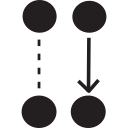
- RCTs only demonstrate general causation but not singular causation. Correlation is also a statistical relationship between two variables, rather than between two singular events.

- As a substitute for RCTs, Hill's criteria also only demonstrate general causation, but can be used in some cases as partial evidence for singular causation (especially plausible mechanism and temporal sequence).

- Any given effect is brought about by a complex combination of many causes (which may interact with each other), with varying degrees of influence on the outcome. This is true for both singular and general causation.

- The omission bias is one explanation for the status quo bias, in that humans tend to prefer not actively changing the current situation or trend, even when it may be worse than the potential pitfalls of the new outcome.
Takeaways
After this lesson, students should
- Distinguish between singular and general causation.
- Distinguish between the evidence needed to establish singular or general causation.
- Identify different policy implications of singular or general causation.
- Recognize cases where omission bias and status quo bias can influence decision making, even when this results in a worse outcome.
Singular Causation
General Causation
Omission Bias
Status Quo Bias
Drug Trials
- A randomized controlled trial for a drug may demonstrate its general therapeutic effect (general causation), e.g. taking this drug reduces the risks of this disease, but it cannot conclusively demonstrate a causal connection in any particular instance of a patient taking this drug (singular causation).
Weather and Climate Change
- One can claim that climate change causes extreme weather events (general causation), but not that any particular instance of wildfire was caused by climate change (singular causation).
This drug will absolutely cure you, because there was a really big RCT that showed it works for your exact disease!
Useful Resources
Recommended Outline
During Class
| 5 Minutes | Introduce the lesson and go over the plan for the day. Make sure people have groups, spokespeople, etc. |
| 35 Minutes | Guide the students through the singular and general causation discussion questions. |
| 15 Minutes | Discuss the trolley problem example. |
| 25 Minutes | Go through the life saving treatments discussion. |
Lesson Content
Have students discuss the following questions in small groups. Each question and sub-question should take around five minutes.
- Which kind of causation can an RCT establish?
- Suppose we conduct an RCT that determines salt causes heart disease. Suppose Sally is in our study, has a high level of salt, and contracts heart disease. Did Sally's salt intake cause her heart disease?
- On January 4, 2022, a federal inquiry into the Dixie Fire of August 2021, the second largest wildfire in California history, determined the wildfire began when a tree came in contact with a power line operated by PG&E.
- Is this a statement of singular or general causation?
- It is well established that climate change increases the number and intensity of wildfires in California. Given this known fact, why did the federal investigation not immediately conclude that climate change was the cause?
- PG&E has faced criminal charges from multiple California counties for the role of its equipment in causing wildfires. When determining guilt or innocence, does the legal system typically focus on singular or general causation?
- Assume you're in charge of creating policy to prevent California wildfires like the Dixie Fire from happening in the future. What are some policies that might have prevented the Dixie Fire? Does policy making typically focus on singular or general causation?
Test
- Why do you think it is so tempting to assume that each event has a singular person or entity to blame? When is this useful or not useful?
Activity 1
[Brief description of and motivation for the activity]
[Common misconception or thing to look out for.]
[Thing you really need to look out for!]
[Title]
[Useful tip, guideline, or other background.]
Instructions
| [n] Minutes | [Activity.] |
| [n] Minutes | [Activity.] |
Discussion Questions
[Question 1]
[Possible misconception that may need to be corrected and clarified.]
[Intended answer to the above question.]
[Question 2]
[Possible misconception that may need to be corrected and clarified.]
[Intended answer to the above question.]