
13.2 Deliberative Polling: Difference between revisions
More actions
// Edit via Wikitext Extension for VSCode |
// Edit via Wikitext Extension for VSCode |
||
| Line 83: | Line 83: | ||
|title=Student Questions Spreadsheet Template | |title=Student Questions Spreadsheet Template | ||
|description=Spreadsheet for keeping track of students' questions over many rounds of deliberation.}} | |description=Spreadsheet for keeping track of students' questions over many rounds of deliberation.}} | ||
{{LinkCard | |||
|url=https://docs.google.com/forms/d/1fb-ifGSSr_fS3HC1b7I5YXHm5P2WW8uPclnLghO7U4A/edit?pli=1 | |||
|title=Example Pre-poll Form | |||
|description=Pre-poll Google form that was used in UC Berkeley's Spring 2023 iteration of the course.}} | |||
{{LinkCard | |||
|url=https://docs.google.com/forms/d/14Brh6PFxwEX2fWXS4mTeZYaCkYmSiYi3QVxj-hkpN6k/edit?pli=1 | |||
|title=Example Post-poll Form | |||
|description=Post-poll Google form that was used in UC Berkeley's Spring 2023 iteration of the course.}} | |||
<br /> | <br /> | ||
| Line 153: | Line 161: | ||
* Host a moderator training session. | * Host a moderator training session. | ||
* Everyone needs to have read the briefing materials. | * Everyone needs to have read the briefing materials. | ||
* Coordinate with | * Coordinate with any extra moderators for your class section. | ||
* Make a pre-poll form. | * Make a pre-poll form. | ||
* Make a post-poll form. | * Make a post-poll form. | ||
| Line 162: | Line 170: | ||
{| class="wikitable" style="margin-left: 0px; margin-right: auto;" | {| class="wikitable" style="margin-left: 0px; margin-right: auto;" | ||
|9 Minutes | |9 Minutes | ||
|Whole class review of deliberative polling and the briefing materials. | |Whole class [[#Deliberative Polling Review|review of deliberative polling]] and the briefing materials. | ||
|- | |- | ||
|1 Minute | |1 Minute | ||
|Give the students the pre-poll and have them do it. | |Give the students the [[#Pre- and Post-poll Forms|pre-poll form]] and have them do it. | ||
|- | |- | ||
|30 Minutes | |30 Minutes | ||
|Run the practice round of deliberation. | |Run the [[#Deliberations|practice round of deliberation]]. | ||
|- | |- | ||
|10 Minutes | |10 Minutes | ||
|Break and chance to read briefing materials for answers. | |Break and chance to read [[#Writing Briefing Materials|briefing materials]] for answers. | ||
|- | |- | ||
|30 Minutes | |30 Minutes | ||
|Run the first round of deliberation. | |Run the [[#Deliberations|first real round of deliberation]]. | ||
|} | |} | ||
| Line 186: | Line 194: | ||
=== Deliberative Polling Review === | === Deliberative Polling Review === | ||
An instructor reviews how deliberative polling works in the real world and explains the deliberative polling agenda. | An instructor reviews how deliberative polling works in the real world and explains the deliberative polling agenda. | ||
{{BoxCaution|The specifics of your deliberative polling schedule will depend a lot on how your course is structured, when you can get guests, and when your course times are. What's written here is one version that's been used previously.}} | {{BoxCaution|The specifics of your deliberative polling schedule will depend a lot on how your course is structured, when you can get guests, and when your course times are. What's written here is one version that's been used previously.}} | ||
A possible version of the schedule: | A possible version of the schedule: | ||
| Line 210: | Line 214: | ||
## Compare results of the pre- and post-poll surveys with the experts present. | ## Compare results of the pre- and post-poll surveys with the experts present. | ||
=== Pre- and Post-poll Forms === | |||
In order to know how students' opinions change, we need to survey their thoughts before and after conducting the deliberative poll. This should be done before they even read the briefing materials and at the very end of the entire process. It doesn't need to be done between each round of deliberation. | |||
{{LinkCard | |||
|url=https://docs.google.com/forms/d/1fb-ifGSSr_fS3HC1b7I5YXHm5P2WW8uPclnLghO7U4A/edit?pli=1 | |||
|title=Example Pre-poll Form | |||
|description=Pre-poll Google form that was used in UC Berkeley's Spring 2023 iteration of the course.}} | |||
{{LinkCard | |||
|url=https://docs.google.com/forms/d/14Brh6PFxwEX2fWXS4mTeZYaCkYmSiYi3QVxj-hkpN6k/edit?pli=1 | |||
|title=Example Post-poll Form | |||
|description=Post-poll Google form that was used in UC Berkeley's Spring 2023 iteration of the course.}} | |||
=== Deliberations === | |||
Students will deliberate in groups of around ten people. The moderators will record students' deliberation questions in the spreadsheet. | |||
{{LinkCard | |||
|url=https://docs.google.com/spreadsheets/d/1URngkiicn0RpXyKEQevcv4eEKwGmMpGw3nVadzOnHvI/ | |||
|title=Student Questions Spreadsheet Template | |||
|description=Spreadsheet for keeping track of students' questions over many rounds of deliberation.}} | |||
The goal of the deliberation is to arrive at questions for the experts.{{NavCard|prev=13.1 Denver Bullet Study|next=14.1 Scenario Planning}} | The goal of the deliberation is to arrive at questions for the experts.{{NavCard|prev=13.1 Denver Bullet Study|next=14.1 Scenario Planning}} | ||
[[Category:Lesson plans]] | [[Category:Lesson plans]] | ||
Revision as of 09:54, 15 August 2023

Another approach to getting groups of people to come together to make decisions, in a process where the integration of facts and values is scaffolded.
The Lesson in Context
Near the end of the course, we introduce some techniques for group decision making that have seen some real-world success. Deliberative polling is one such method that allows citizens to make a democratic decision on some policy option in accordance with their values but with the knowledge of experts at their disposal.
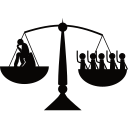
- Students are familiar with the tension between facts in an epistocracy and values in a democracy. The primary purpose of a deliberative poll is to resolve this conflict by giving members of the general public access to the narrow expertise needed for some difficult policy decision.

- Deliberative polling may be able to help resolve the issues of status quo bias in policy making. It does so by forcing people to carefully consider a wider array of policy options as well as the implications and consequences of each.
- However, people are not immune to their other biases just because they're in a deliberative poll. Omission bias can still be a strong motivator in determining which policy the members of the public select.

- Selective exposure can be addressed by deliberative polling since all the participants (both members of the general public and experts) are forced to be exposed to multiple sides of whatever policy they're debating.
- Deliberative polling does not necessarily help with biased assimilation.

- In the Denver Bullet Study method, the final recommendation is provided by experts to match the values put forth by various stakeholders. The citizens don't need to know about the technical details at all. All they have to worry about are the values. In deliberative polling, the experts are there to inform the general public who are integrating facts and values for themselves.
Takeaways
After this lesson, students should
- Be optimistic about the possibility of integrating the perspectives and insights of both experts and stakeholders in forming effective policies with community buy-in.
- Recognize problems which could be resolved effectively using deliberative polling.
Deliberative Polling
- Participants are not required to come to an agreement.
- Participants are asked to speak to the facts presented in the briefing material, rather than try to convince other group members of their position.
- Experts are only there to answer questions posed by participants, rather than try to convince people of their own position.
- Each small group is moderated by a neutral moderator.
Deliberative Democracy Lab
America One Room Experiment
Useful Resources
Deliberative Polling Moderator Guide
Instructions for moderators to read prior to deliberative polling.
Student Questions Spreadsheet Template
Spreadsheet for keeping track of students' questions over many rounds of deliberation.
Recommended Outline
Before Class
Developing a Topic
Deciding on a Topic
The following are some desiderata for a good deliberative polling topic for SSS.
- The topic has wide societal relevance.
- The topic involves understanding some technical background, which can be provided by the briefing material and the expert panel.
- There is a range of policy options on which it is possible to find experts who would make different policy recommendations.
- Students either do not yet hold a strong opinion on the topic, or are divided in their policy choices.
To determine the range of expert opinions, it is necessary to contact some relevant experts by email or phone for a conversation.
To determine the range of student opinions, a preliminary poll may be sent out to ask students to choose a policy option for each of several candidate topics.
Writing the Briefing Materials
The briefing material should give a short review (15-20 pages) of the societal and historical context of the issue, the relevant technical background, and various policy options, as well as their pros and cons. It should be written by the teaching staff long ahead of the event and reviewed by at least one relevant expert for accuracy and comprehensiveness.
Recruiting Experts
A list of relevant experts for each topic should be compiled at least three months ahead of the event. They may be from the Bay Area and invited to join in person, or beyond and invited to join virtually. While the net should be cast wide initially, a final panel of 4 to 6 experts should be assembled to maximize the range of opinions represented. We have typically asked some of the experts to take on a position that they do not personally take, with a friendly disclaimer announced at the beginning of the event. Some of the experts should be contacted early on to get their input on the range of opinions and the quality of the briefing materials.
Recruiting Moderators
Several rounds of deliberation will be conducted in groups of 10 students. Two rounds will occur during discussion section (~30 students each), and two more rounds during plenary with an expert panel. During each round of deliberation, every group will be moderated by a moderator. Course staff members should all be recruited, if available. Former course staff members and top performing former students can also be invited to be volunteer moderators. The faculty should not serve as moderators so as to allow students to speak more freely. Some reserve moderators should be prepared in case some moderators have to drop out at the last minute.
Expectations for Moderators
Once the team of moderators has been assembled, it is important to hold a short briefing session. The moderators are explained the following expectation:
- Be familiar with the content of the briefing material ahead of the event.
- Bring their laptop to write down questions during deliberation.
- Introduce themselves and start a short round of introduction around the group.
- Moderate the amount of time each member of the group speaks by politely cutting off dominating members and inviting opinions from quieter ones, e.g. "We have heard from some of our members. Would others like to add to that?"
- Refer the group to particular sections of the briefing material when there is factual disagreement between members.
- Refrain to expressing the moderator's own opinion on the subject.
Immediate Class Preparation
- Host a moderator training session.
- Everyone needs to have read the briefing materials.
- Coordinate with any extra moderators for your class section.
- Make a pre-poll form.
- Make a post-poll form.
- Make a spreadsheet to put student questions on.
During Class
| 9 Minutes | Whole class review of deliberative polling and the briefing materials. |
| 1 Minute | Give the students the pre-poll form and have them do it. |
| 30 Minutes | Run the practice round of deliberation. |
| 10 Minutes | Break and chance to read briefing materials for answers. |
| 30 Minutes | Run the first real round of deliberation. |
After Class
- Compile the questions and make sure it's clear which students are asking them.
- Someone will go through the questions and decide which ones to ask.
Lesson Content
Deliberative Polling Review
An instructor reviews how deliberative polling works in the real world and explains the deliberative polling agenda.
The specifics of your deliberative polling schedule will depend a lot on how your course is structured, when you can get guests, and when your course times are. What's written here is one version that's been used previously.
A possible version of the schedule:
- Section
- Pre-poll survey.
- Practice round of deliberation.
- Review the briefing materials to see what question we can answer.
- First real round of deliberation.
- Between section and lecture
- Someone selects questions.
- Lecture
- First panel discussion with the experts.
- Second round of deliberation.
- Someone selects questions.
- Second panel discussion with experts.
- Third round of deliberation.
- Maybe a third panel discussion with experts.
- Post-poll survey.
- Compare results of the pre- and post-poll surveys with the experts present.
Pre- and Post-poll Forms
In order to know how students' opinions change, we need to survey their thoughts before and after conducting the deliberative poll. This should be done before they even read the briefing materials and at the very end of the entire process. It doesn't need to be done between each round of deliberation.
Deliberations
Students will deliberate in groups of around ten people. The moderators will record students' deliberation questions in the spreadsheet.
Student Questions Spreadsheet Template
Spreadsheet for keeping track of students' questions over many rounds of deliberation.
The goal of the deliberation is to arrive at questions for the experts.