
4.1 Signal and Noise: Difference between revisions
More actions
No edit summary |
No edit summary |
||
| Line 1: | Line 1: | ||
{{Cover|4.1 Signal and Noise}} | |||
To make sense of this complex world, how do we confidently identify a meaningful pattern amongst a myriad of distractions? Scientists call the pattern "signal" and the distractions "noise." We clarify this subtle distinction and introduce techniques to make the signal stand out from the noise, such as with the use of filters. | To make sense of this complex world, how do we confidently identify a meaningful pattern amongst a myriad of distractions? Scientists call the pattern "signal" and the distractions "noise." We clarify this subtle distinction and introduce techniques to make the signal stand out from the noise, such as with the use of filters. | ||
Revision as of 20:29, 21 February 2024
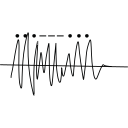
To make sense of this complex world, how do we confidently identify a meaningful pattern amongst a myriad of distractions? Scientists call the pattern "signal" and the distractions "noise." We clarify this subtle distinction and introduce techniques to make the signal stand out from the noise, such as with the use of filters.
The Lesson in Context
We introduce the concept of signal and noise in "detection problems" and teach students how to identify the signal and various sources of noise in diverse scenarios. This foreshadows the ethical considerations in deciding how strong a signal must be to be counted as a "positive".
Earlier Lessons

- Both systematic and statistical uncertainties introduce noise to every measurement.

- The presence of noise, which sometimes disguises as a signal, is inevitable in any measurement. The identification of a signal always comes with a roughly quantifiable level of confidence.
Later Lessons
- In addition to the signal-to-noise ratio, there are other statistical tools (e.g. [math]\displaystyle{ p }[/math]-value) to quantify the strength of the signal amidst all the noise.

- "Positive" and "negative" refer to whether we identify what we detect as a signal or not. The decision of any "threshold" of strength for a signal to be counted as positive inevitably involves human values judgment in a trade-off between the rates of false positives and false negatives.

- Some signals in nature seem hopelessly too weak to detect, such as the tiny fluctuations in the distance between two mirrors as a result of the gravitational waves from faraway black holes, but scientists spend decades to develop new instruments to increase the strength of the signal, as well as new analysis techniques to filter out the noise.
- The detection of a "statistically significant" difference between conditions in an RCT is the identification of a signal. The random variations that exist between experimental subjects are a source of noise.
Takeaways
After this lesson, students should
- Be able to explain what scientists mean by "signal," "noise," and "signal-to-noise ratio."
- Be able to identify examples of "signal" and "noise," recognizing that these examples are context-dependent.
- Be able to roughly compare measurement techniques in terms of their resultant signal-to-noise ratios.
- Be able to describe examples of techniques and tools to suppress noise and/or amplify signal.
Signal
Please hold off on introducing the concept of false positive/negative or thresholds in detections, as students have previously been overwhelmed and confused. We will properly discuss them in 5.1 False Positives and Negatives.
Noise
Some students falsely think that noise is anything that prevents you from detecting the signal, for instance, a law banning the use of ultrasound to detect the sex of the foetus. In fact, noise is something that is detected by an instrument the same way a signal would be, except that it is not caused by the source of the signal and could be confused with the signal.
There is always random background noise. But, noise doesn't have to be random.
Noise does not have to be sound.
Signal-to-noise Ratio
Bajau People
- As a member of the Bajau people of Southeast Asia, you are diving to collect shellfish for food. While the shellfish themselves are the signal, there are several sources of noise: rocks and other creatures resembling shellfish, waving sunlight patterns on the seafloor. The signal-to-noise ratio may be low if the water is murky (higher noise), the shellfish are camouflaged (lower signal), or if the light is dim (lower signal). (BBC Article)
Identifying Fish
- Detecting fish jumps (signal) on a lake on a day when the wind is causing waves (noise). Some splashing waves may be misidentified as fish jumps.
Radio Static
- Getting the words of a radio personality through static.
Loud Party
- Hearing your conversational partner at a party where lots of conversations are happening.
Randomized Controlled Trials
- Figuring out if there's a meaningful difference between the control condition and experimental condition in an RCT. Random fluctuations in the chosen experimental sample may cause a spurious difference between the two groups; this is a source of noise.
We will cover RCTs in detail in 6.1 Correlation and Causation.
Online Researching
- Finding the facts on a topic where there's a lot of disinformation floating around.
Palette Cleansing
- Palette cleansing with water or crackers between tasting different wines. The subtle differences between wines are the signal, while lingering flavours and scents from the previous wine are the noise.
COVID Symptom Screening
- The signal is the actual COVID infection, and the noise is all the other illnesses/allergies/etc causing similar symptoms.
Smoke Detectors
- Smoke detectors detect the presence of smoke from a fire (signal) by measuring the opacity of air. Steam is a possible source of noise.
Additional Content
You must be logged in to see this content.