
10.1 Confirmation Bias
More actions

Our tendency to preserve our existing or preferred beliefs, even against the evidence.
The Lesson in Context
This lesson continues the lessons on cognitive heuristics and biases, reminding us that even careful scientists can fall prey to such human tendencies. 10.2 Blinding will introduce techniques to counter these tendencies. In this lesson, we let students fall into the trap of biased assimilation by asking them to evaluate the same news article that is labelled leftwing for one group and rightwing for the other.

- Both biased assimilation and selective exposure introduce a systematic bias in our perception and assessment towards a direction that confirms our existing beliefs.

- Actively open-minded thinking aims to measure one's avoidance of confirmation bias. It assesses whether one actively seeks out arguments contrary to their prior beliefs and evaluates evidence objectively independently of their beliefs.

- Selective exposure together with the availability heuristic can exacerbate the bias in one's belief.

- Blind analysis and preregistration are techniques to reduce motivated reasoning during the data collection and analysis process.
Takeaways
After this lesson, students should
- Be wary of one's own tendency towards motivated reasoning and confirmation bias.
- Be able to explain and differentiate the two mechanisms for confirmation bias, selective exposure and biased assimilation.
- Be able to identify cases of selective exposure.
- Be able to identify cases where biased assimilation is likely.
- Be able to explain how confirmation bias can lead to errors.
- Know how to reduce confirmation bias by actively seeking out and examining counter-evidence to their own beliefs.
Confirmation Bias
- Selective Exposure
- Biased Assimilation
Social Media
- Modern social media offer a perfect environment for selective exposure, where one only chooses to view content created by those that already confirm their preexisting worldview or beliefs. Content moderation algorithms of major websites exacerbate the problem by reinforcing one's choice in the type of "desirable" content, leading to the "filter bubble".
Bug Fixing
- As a counterexample, when testing whether a web form taking an email address has been coded correctly, a programmer not only tries "sensesensibilityscience@berkeley.edu" to see if it works, but also non-email address strings like "https://berkeley.edu", "laf1209#$%^&", "Robert; DROP TABLE Students" to see if it breaks. The programmer actively seeks to disconfirm their hypothesis that "the web form is coded correctly".
Hubble Parameter
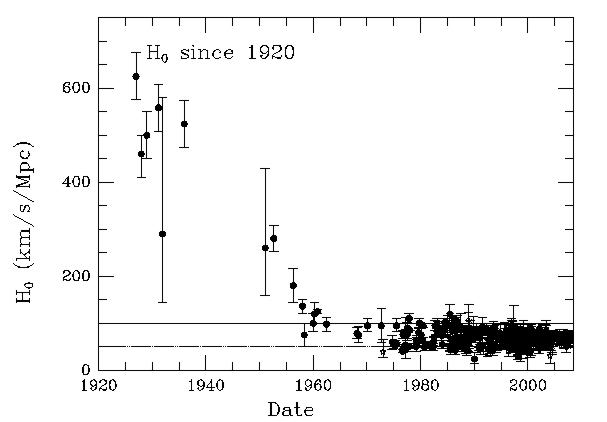
- The measured value of the Hubble parameter (which describes the speed of the expansion of the Universe) published over time. The few early measurements are clearly too far away from the currently accepted value and overconfident, but they confirmed the accepted value at that time. As soon as one deviating value was published, a slew of publications finally came to support this new value.

[Description of misconception.]
[Description of misconception.]
Useful Resources
[[address] Discussion Slides Template]
[[address] The discussion slides for this lesson.]
[[address] [Title]]
[[address] [Description.]]
[[address] [Title]]
[[address] [Description.]]
[[address] [Title]]
[[address] [Description.]]
[[address] [Title]]
[[address] [Description.]]
Recommended Outline
Before Class
[Any steps that need to be taken before class.]
During Class
| [n] Minutes | [Activity.] |
| [n] Minutes | [Activity.] |
Lesson Content
Activity 1
[Brief description of and motivation for the activity]
[Common misconception or thing to look out for.]
[Thing you really need to look out for!]
[Title]
[Useful tip, guideline, or other background.]
Instructions
| [n] Minutes | [Activity.] |
| [n] Minutes | [Activity.] |
Discussion Questions
[Question 1]
[Possible misconception that may need to be corrected and clarified.]
[Intended answer to the above question.]
[Question 2]
[Possible misconception that may need to be corrected and clarified.]
[Intended answer to the above question.]